

13 Oct, 2026
ISO 9001 vs ISO 45001: Which Certification Does Your Business Need First?
Quick answer
Start with ISO 9001 if customer requirements, quality problems or business growth are your biggest priority. Start with ISO 45001 if your workplace carries high health and safety risks, faces strict regulation or has had safety incidents. Both standards share the ISO High-Level Structure, so many organisations later integrate them into one management system.
A common question from organisations beginning their journey to a management system is where do we start? Quality management or Occupational Health and Safety.
The answer is probably to be found somewhere in your business objectives, customer requirements, operational risks and your own sector and industry expectations.
ISO 9001 and ISO 45001 are international standards with similar ISO certification timeline, and are the leaders in their respective fields.
The first is to be able to reliably produce goods and services that consistently meet customer needs and regulatory requirements. The second is to have safe and healthy work places where injury and disease are avoided at work.
Neither are more important than the other. Generally it is advised you start with where your organisation faces the biggest challenges and opportunities.
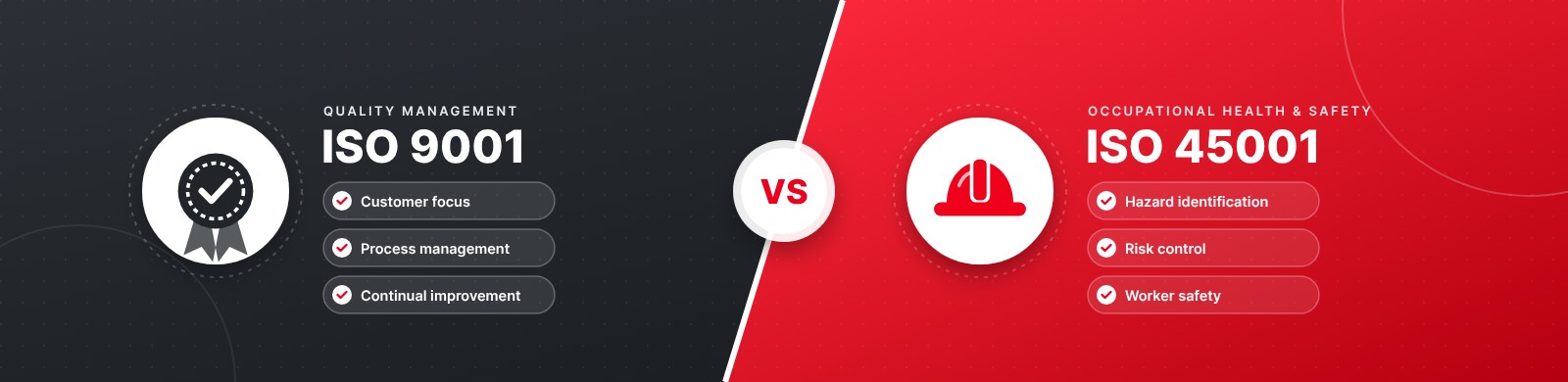
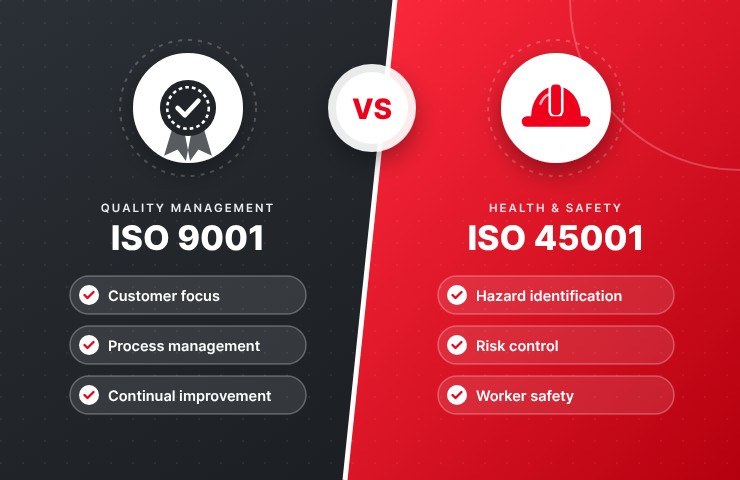
ISO 9001 and ISO 45001 at a Glance
Quality management
What is ISO 9001?
The most recognised of all Quality Management System Standards in the world is ISO 9001. This provides organisations with a framework to follow for designing, implementing and monitoring a QMS for an increase in customer satisfaction. Its focus is on performance management and improvement in order to achieve organisational objectives and continual improvement.
ISO 9001 does not specify how organisations should conduct business but offers general requirements for effective business management systems, which will include planning, monitoring and improvement processes.
ISO 9001 Key Areas
There are many reasons why organisations are interested in obtaining ISO 9001 certification. Some of such reasons include building customer trust, optimising operations, minimising defects or facilitating growth in business. For a lot of companies, ISO 9001 is the base upon which other management systems are built later on.
Occupational health & safety
What is ISO 45001?
ISO 45001 is an international standard for Occupational Health and Safety Management Systems (OHSMS).
ISO 45001’s primary aim is assisting organisations in identifying hazards in the workplace, evaluating risks, applying controls and therefore facilitating a safer working context for employees, contractors and visitors.
The Standard pushes organisations for managing health and safety risks in the proactive way instead of reactive.
ISO 45001 Key Areas
This standard is designed to help organisations identify, reduce and control risks at work, to assist in developing a safety culture in the workplace, to improve performance related to their requirements and for demonstrating their commitment to the value of their employees.
What’s the Difference Between ISO 9001 and ISO 45001?
While both standards are based on the ISO High-Level Structure and contain many of the same principles of a management system, they are intended for completely different objectives.
ISO 9001 questions
“How do we deliver quality products and services consistently?”
ISO 45001 questions
“How can we prevent workplace injuries and provide a safe working environment?”
One standard is about customers and business performance. The other is about workers and occupational health and safety.
Understanding these functions will help businesses determine what business problem to try to fix first.
Prioritising ISO 9001
ISO 9001 should definitely be the best to start with and a priority for many businesses and organisations if:
Certification driven by customer requirements
Many customers, especially in the manufacturing, engineering, technology and professional services sectors, expect their suppliers to have a recognised quality management system. In some industries, ISO 9001 certification is a pre-requisite for tender, contract or approved supplier programme.
You are facing quality-related challenges such as
Complaints from clientsDefects in the productInconsistencies in the processProblems with deliveryRework and waste
ISO 9001 can be applied as a structured framework to identify the root causes and improve the performance.
You are new to building management systems
ISO 9001 is concerned with process management and organisational controls so many organisations adopt it as their first management system standard. The discipline applied in implementing ISO 9001 often assists in achieving other certifications.
Emphasise growth and scalability
Fast business growth can often be attributed to the implementation of standardised operations, well-defined roles and mechanisms to review their effectiveness. The certification process for ISO 9001 can facilitate the building of a framework to sustain business growth.
Prioritising ISO 45001
There are specific scenarios where occupational health and safety should be given a higher priority. You may need to give priority to ISO 45001 if:
Risks at the workplace are huge
The construction, manufacturing, mining, energy, transport, heavy industry and engineering sectors tend to involve heightened health and safety risks. This factor alone can impact employees’ wellbeing and business productivity, depending on the managed risks.
Regulatory compliance is a major concern
For organisations that operate in highly regulated industries, workplace health and safety can imply legal compliance issues. ISO 45001 assists businesses in identifying and addressing these concerns by establishing standardised occupational health and safety management systems.
Safety incidents are impacting performance
Where an organisation has had workplace incidents, near misses, injuries or recurring safety concerns then strengthening health and safety management may be more urgent than seeking quality improvements.
Your strategic priority is your people
Many organisations are realising that good safety performance plays a crucial role in employee engagement, retention, productivity and organisational culture. By adhering to ISO 45001 standard they demonstrate their commitment to worker’s safety and wellbeing, as well as improving job satisfaction of employees.
Can Companies Implement Both Standards?
Yes, it’s entirely possible for a company to integrate ISO 9001 and ISO 45001 into one management system. They use compatible structures. Both standards have been developed based on similar clauses, including:
Taking a consolidated approach can alleviate duplication, improve documentation and management system efficiencies, as well as enhance overall management system effectiveness.
That being said, in some cases implementing both standards simultaneously may demand additional resources, training and internal cooperation.
Prioritising one standard at a time allows organisations with smaller budgets to slowly build capability prior to expanding into more standards.
Industries Most Commonly Associated with Each Standard
ISO 9001
Industries most commonly associated with ISO 9001
These organisations usually have a high customer satisfaction level outlook, quality performance and processes consistency.
ISO 45001
Industries most commonly associated with ISO 45001
These industries are susceptible to higher occupational health and safety risks and regulatory scrutiny.
A Better Question: What Risk Would Have the Biggest Impact on Your Business at the Moment?
Choose ISO 9001
If it is the inconsistencies in your processes, the customer complaints and quality control problems that are hindering your ability to grow, then ISO 9001 could give you the most benefit.
Choose ISO 45001
But if it is the health and safety of your employees that you are most concerned about, ISO 45001 should be your priority.
The decision should be based on your organisation’s strategic objectives, not just on market conditions.
The QACA Perspective
In practice, many organisations benefit from introducing both ISO 9001 and ISO 45001 standards. Quality and safety do not compete with each other: a conscientious company and an excellent product or service are inseparable concepts.
The most sensible approach to the problem is to determine which business needs are most pressing at the moment and which ones can be postponed. After all, every company has unique requirements for its development and the choice of the standard to implement should be strategic, not accidental.
Quality Austria Central Asia can help you identify the most pressing risks for your business operations and determine the expectations of your clients and regulators in the shortest possible time. It is also critical to consider the necessary changes to achieve sustainable growth.
Whether you start improving quality management and business processes according to ISO 9001, begin introducing occupational health and safety management according to ISO 45001 or decide to implement both management systems at once, the primary goal should remain the same: create added value for your clients while ensuring the safety of your employees.
Find the Right Starting Point with Quality Austria Central Asia
Not sure which standard to start with? Talk to our certification team about your risks and customer requirements, or explore our ISO 9001 and ISO 45001 certification services.
Talk to our certification teamISO 9001 CertificationISO 45001 Certification
Related Reading
Social Share: