



20 Apr, 2026
ISO 14001:2026 Is Here. Your Transition Clock Has Started
The International Organization for Standardization has published ISO 14001:2026, the new edition of the world's most widely used environmental management standard. For Indian organisations, this is not a distant development to monitor; it is a live transition with a firm deadline.
ISO 14001 sets the requirements for an Environmental Management System (EMS), giving organisations a structured way to reduce their environmental footprint, stay compliant with regulations and demonstrate genuine sustainability performance. The 2026 edition replaces ISO 14001:2015 and carries a three-year transition window. All current certificates issued under the 2015 edition must be transitioned to the 2026 version before May 2029 to remain valid.
The publication matters because the standard is trusted by more than 670,000 certified organisations worldwide. India, alongside China and Japan, is one of the largest and fastest-growing markets for ISO 14001 certification in Asia-Pacific. As ESG scrutiny intensifies across global supply chains, the 2026 revision raises the bar on what credible environmental management looks like and Indian organisations that move early will gain a real competitive edge.
- 670,000+ Certified organisations globally (ISO Survey 2024)
- 0.14% Drop in GHG emissions per unit of GDP for every 1% rise in ISO 14001 adoption
- May 2029 Hard deadline for transition from ISO 14001:2015
What Has Actually Changed:
This revision does not reinvent the standard. Organisations already certified to ISO 14001:2015 are not starting over. The core framework, the Plan-Do-Check-Act cycle and the Harmonised Structure (Annex SL) all remain intact. What the 2026 edition does is sharpen the focus, close ambiguous gaps in the 2015 text and align the standard with environmental realities that have changed significantly over the past decade.
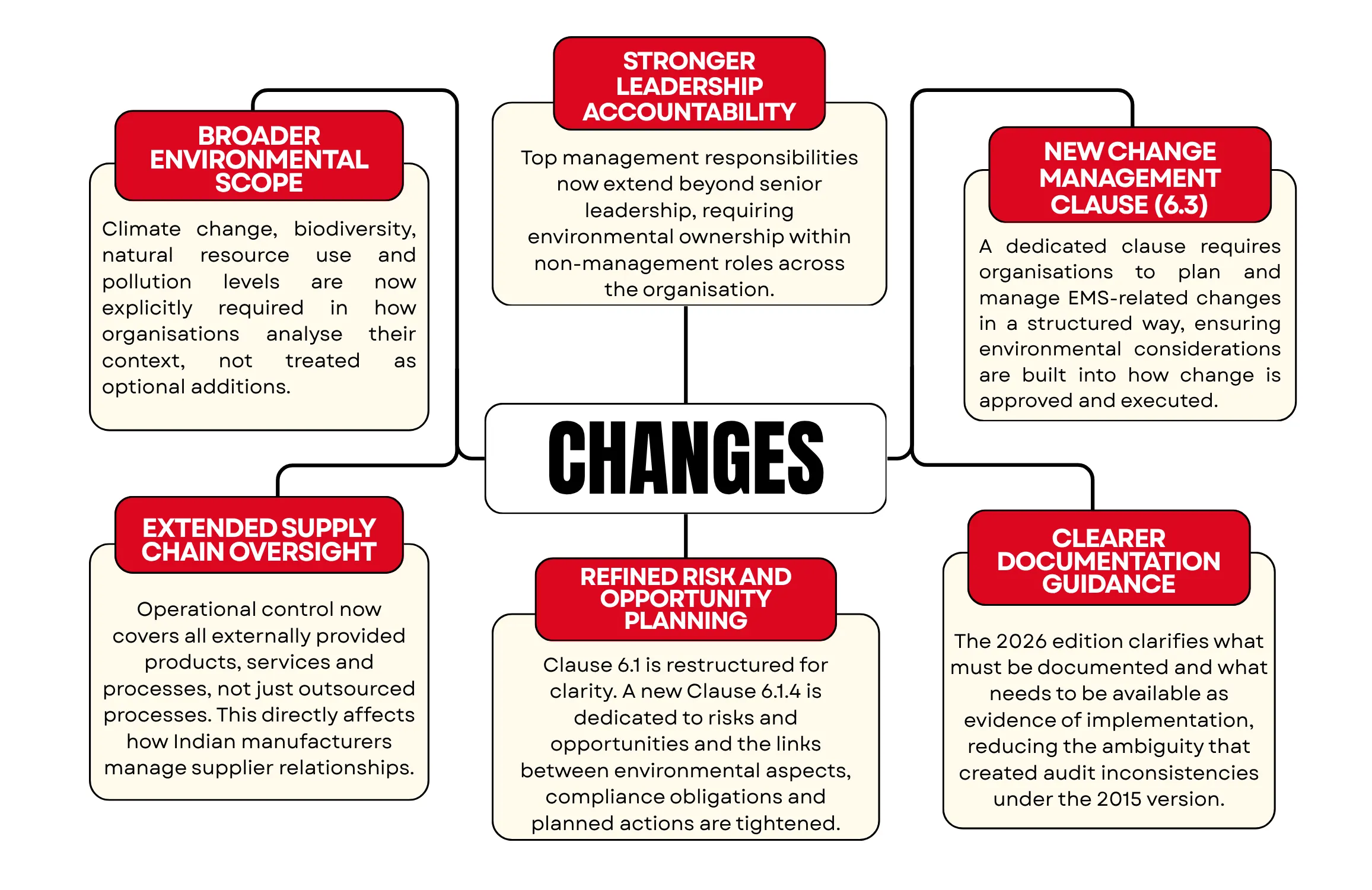
These changes also include substantial improvements to Annex A, the guidance section, which has been revised to support better interpretation of requirements across Clauses 4 to 10. For auditors and internal teams alike, this makes the standard significantly easier to apply consistently.
Why This Matters for Indian Organisations Right Now
India's business environment is at an inflection point on environmental responsibility. Regulatory pressure under the Environment Protection Act, mandatory ESG reporting requirements for listed companies and the expectations of international buyers are all converging at once. ISO 14001:2026 directly supports every one of these fronts.
For manufacturing and export-oriented businesses, the supplier oversight changes in the 2026 edition are particularly significant. Global buyers increasingly require their Indian suppliers to demonstrate end-to-end environmental accountability, not just at the factory gate but across the value chain. The revised standard equips organisations to build exactly this kind of traceable, evidenced environmental control.
Preliminary research by the Standards Council of Canada, drawing on data from 83 countries over more than two decades, found that a 1% increase in ISO 14001 certifications is associated with a 0.14% decrease in greenhouse gas emissions per unit of GDP. Certification drives measurable results, not just documentation.
The 2026 edition also brings tighter integration with ISO 9001 (Quality Management) and ISO 45001 (Occupational Health and Safety) through the updated Harmonised Structure. For Indian organisations already holding integrated management system certifications, this simplifies the audit process and reduces the administrative burden of maintaining multiple systems.
For companies that have not yet certified, the 2026 edition is the right version to implement from the start. Beginning with ISO 14001:2026 rather than the 2015 version avoids a second transition effort within months of certification.
Your Transition Timeline
The International Accreditation Forum (IAF) has proposed a three-year transition period. Based on this, organisations need to complete their transition audit against the 2026 edition before May 2029. Three years sounds comfortable but the organisations that start now are the ones that handle the transition calmly and strategically, rather than scrambling in 2028.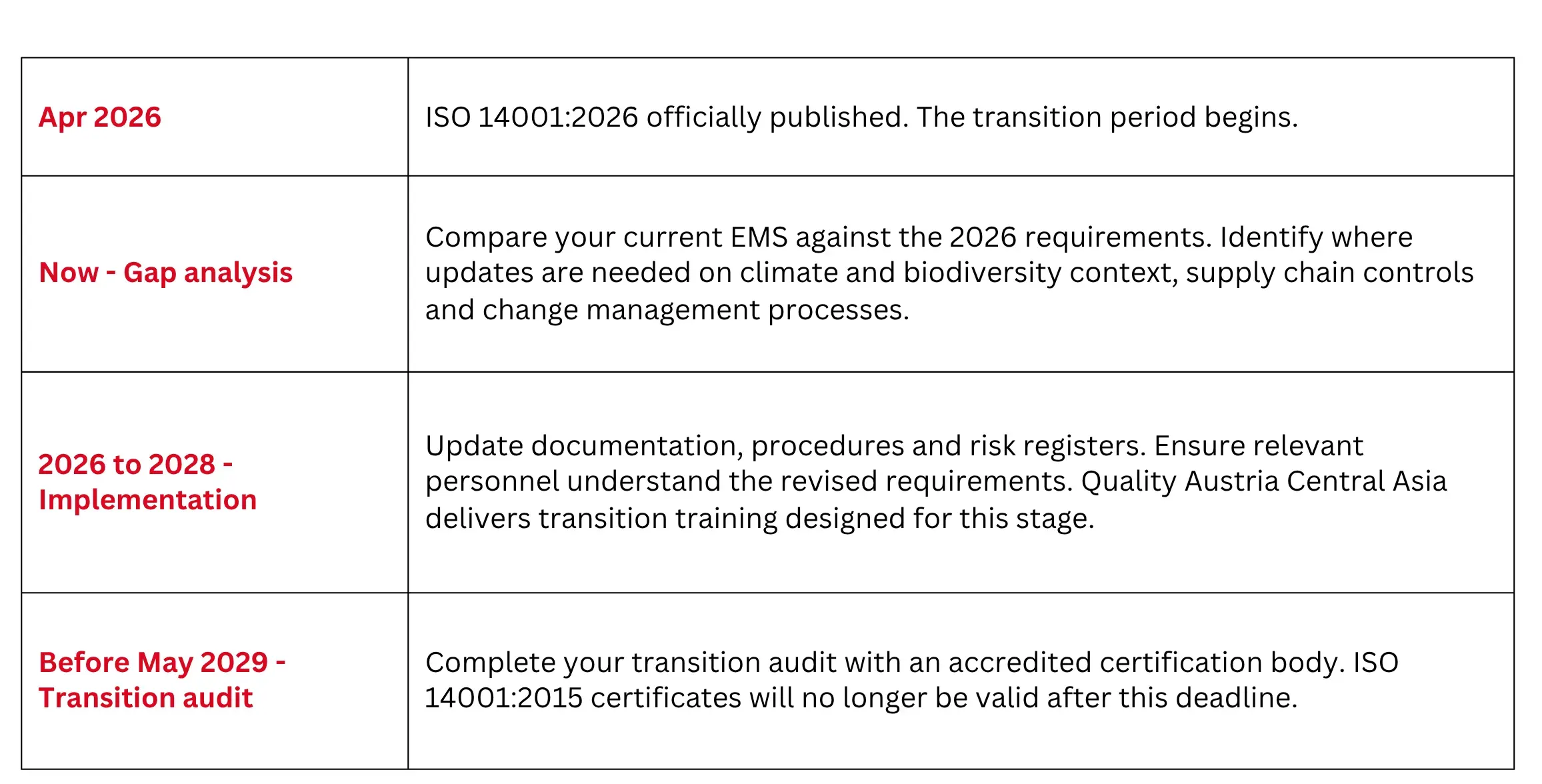
The Performance Case, Not Just the Compliance Case
There is a common temptation to treat ISO 14001 as a certification exercise, something that produces a certificate and lives largely in documentation. The 2026 revision actively pushes back against this approach. The standard is designed to produce measurable environmental results: reductions in emissions, waste, energy consumption and resource use that show up in operational performance, not just audit records.
ISO Secretary-General Sergio Mujica stated at publication that the new edition is built to help organisations turn environmental commitment into performance, resilience and lasting value. For Indian organisations competing in international markets, that performance story is increasingly what customers, investors and regulators want to see backed by independent third-party evidence.
Quality Austria Central Asia has supported hundreds of organisations across India, Central Asia and the wider region in achieving and maintaining ISO 14001 certification. Our auditors combine deep technical knowledge of environmental management with sector-specific experience across manufacturing, infrastructure, pharmaceuticals, logistics and more.
Start Your ISO 14001:2026 Transition Today
The transition deadline is May 2029. Organisations that begin now have the time to implement the changes properly, train their teams and demonstrate environmental leadership rather than minimum compliance.
Contact us today to book a free gap assessment or request guidance on transition.
For any queries or further information related to our services, For any queries or further information related to our services, please feel free to contact us at info@qacamail.com or call us at +919599619392. We are here to assist you!
Social Share: