



13 Apr, 2026
FSSC 22000 Version 7 Explained: What Food Businesses Must Do Now
If you are certified to FSSC 22000 or working towards it, now is the time to pay attention. Foundation FSSC has confirmed that Version 7 of the FSSC 22000 Scheme is expected to be published in early May 2026 and the changes it brings are more than just a routine update.
FSSC 22000 is one of the most globally recognised food safety standards and Version 7 has been developed to align it with new industry requirements and global trends. At its core, the revision addresses three big shifts:
- Incorporating the new ISO 22002-x:2025 series on prerequisite programs
- Aligning the scheme with the GFSI Benchmarking Requirements version 2024
- Strengthening requirements to support organisations in contributing to the Sustainable Development Goals (SDGs)
The updates are also expected to include changes in product categories, audit duration and additional FSSC requirements in areas such as food loss and waste, quality control, equipment management, allergen management and the integration of food safety and quality culture requirements.
Once published, Certification Bodies and certified organisations will receive a 12-month transition period to implement the new version. That window sounds generous but given the scope of changes, organisations that start preparing early will be in a much stronger position than those who wait.
In this blog, we break down what’s actually changing, why it matters and what your organisation should be doing right now to prepare.
FSSC 22000 Version 6 v/s FSSC 22000 Version 7: What Has Changed
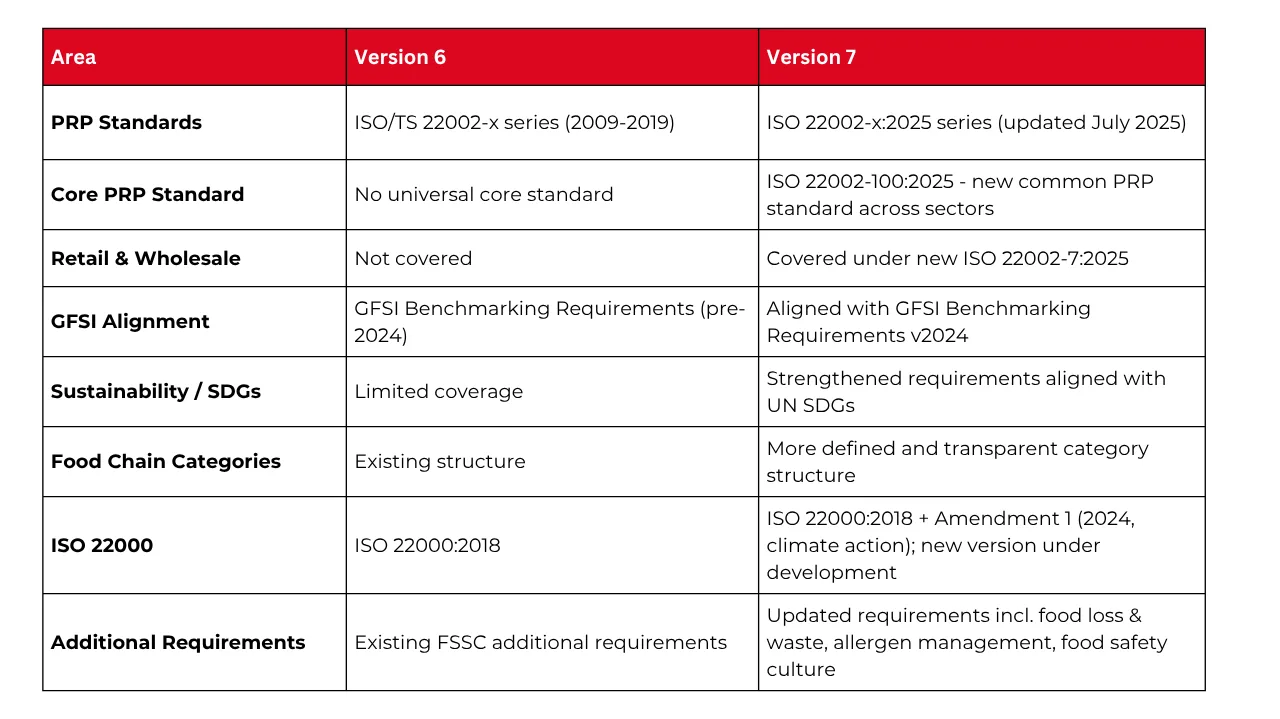
Changes in FSSC 22000 Version 7
Version 7 is not a cosmetic refresh. It touches the foundational documents that FSSC 22000 is built on, expands its scope to new sectors and raises the bar on sustainability. Here is a breakdown of the key changes.
-
A New PRP Framework - The most structurally significant change in FSSC 22000 Version 7 is the adoption of the updated prerequisite programme (PRP) standards. The ISO/TS 22002 series has been updated and republished on 29th July 2025 as the ISO 22002-x:2025 series, with the transition from ISO/TS 22002 designed to allow for greater global applicability.
What this means: Organisations will need to review and update their PRP documentation to align with the new ISO 22002-x:2025 standards. Gap assessments against the updated requirements will be essential before transition audits.
-
A New Sector: Retail and Wholesale - Version 7 also brings a sector into the fold that was not previously covered. ISO 22002-7:2025 is a newly introduced standard for Retail and Wholesale, covering businesses that store goods for distribution. This is a meaningful expansion of the scheme's reach across the food supply chain.
What this means: Retail and wholesale businesses can now pursue FSSC 22000 certification for the first time, opening up new opportunities to demonstrate food safety compliance to customers and supply chain partners.
-
Alignment with GFSI 2024 - Version 7 is intended to align with the latest GFSI Benchmarking Requirements version 2024, ensuring the continued international acceptance of FSSC 22000 certification. For organisations that rely on FSSC 22000 to access global markets and satisfy major retail buyers, this alignment is critical. It means the scheme continues to carry the same weight it always has at the international level.
What this means: Organisations can maintain access to international markets and major retail buyers without disruption. FSSC 22000 certification continues to carry its full weight at the global level.
-
Stronger Focus on Sustainability - The scheme revision integrates sustainability-related topics and aims to enhance trust throughout the value chain. Public communications from the Foundation indicate an increased emphasis on sustainability considerations and contributions to the UN Sustainable Development Goals within the scheme framework. Food businesses will be expected to demonstrate how their operations connect to these broader global priorities, not just meet the technical food safety requirements.
What this means: Food businesses will be expected to demonstrate how their operations connect to broader sustainability priorities. Organisations that already track environmental and social performance will be better positioned; those that do not will need to build this into their management systems.
-
Updates to ISO 22000 Itself - Alongside the PRP changes, the base standard is also evolving. ISO 22000:2018 received Amendment 1 in early 2024, addressing climate action and a new version of ISO 22000 is currently under development with the draft under review by the relevant working group.
What this means: Organisations should ensure their food safety management system already reflects Amendment 1 of ISO 22000:2018. The development of a full new version of ISO 22000 is a signal that further updates are on the horizon beyond Version 7.
It is worth noting that organisations currently certified under Version 6 do not need to panic. FSSC 22000 Version 6 continues to utilise the existing ISO/TS 22002-X series as defined under the scheme and the previous ISO/TS 22002-X series remains available to purchase from National Standards Bodies. Your current certification remains valid until the transition deadline.
Why This Update Happened
The FSSC Version 7 reflects several converging pressures. The most immediate driver was technical: the ISO 22002-x:2025 series was published on 29th July 2025 and incorporating these updated PRP standards into the scheme was a logical next step.
At the same time, aligning the scheme with the GFSI Benchmarking Requirements version 2024 was a key factor behind the revision, ensuring FSSC 22000 certification retains its international recognition with major retailers and supply chains worldwide.
Sustainability added further momentum. Regulators, consumers and investors are all asking food businesses to account for their environmental and social impact and certification schemes are responding.
The revision aims to integrate sustainability-related topics and enhance trust throughout the value chain, making clear that food safety and responsible business practice are no longer separate conversations.
A more defined structure for food chain categories and editorial improvements round out the update as part of the Foundation's ongoing commitment to continuous improvement.
Transition Timeline
Foundation FSSC has confirmed that Version 7 is expected to be published in early May 2026, with a public webinar introducing the new version scheduled for 6th May 2026. That webinar will be the first opportunity for organisations and certification bodies to hear the full details directly from the source.
Until then, there is no disruption to existing certificates. FSSC 22000 Version 6 remains valid and continues to use the existing ISO/TS 22002-X series until Version 7 is released.
Once published, all Certification Bodies and certified organisations will receive a 12-month transition period to implement the new requirements. Most organisations will therefore be looking at transition audits falling somewhere between mid-2026 and mid-2027, depending on their existing certification cycle.
Twelve months sounds comfortable but the changes to the PRP framework, sustainability requirements and category structure mean that a last-minute approach will cost you. Starting early is the only sensible strategy.
What to Do Next
The May 2026 publication date is close and the 12-month transition clock starts the moment Version 7 goes live. The key steps for any organisation are to review the published changes as soon as the new version becomes available, train relevant personnel on the updated requirements, conduct a gap assessment to identify areas needing adjustment and implement the necessary updates to processes and documentation. Organisations that build this into their planning now will avoid the scramble that comes with leaving it too late.
With Version 7 approaching fast, early preparation is the difference between a smooth transition and a costly scramble.
At Quality Austria Central Asia, we help organisations assess readiness, close compliance gaps and transition confidently. Speak to our experts today to get ahead of the deadline.
Related Links:
- FSSC 22000 Food Safety
- FSSC 22000 Version 6 Internal Auditor Training Course
- ISO 22000 Food Safety Management System
- ISO 22000 Food Safety Management System Internal Auditor Course
For any queries or further information related to our services, please feel free to contact us at info@qacamail.com or call us at +919599619392. We are here to assist you!
Social Share: